


Markup vs margin: the contractor's guide (with table)
In this article
- Markup vs margin: the formulas
- Markup to margin conversion table
- Gross margin vs net margin
- How to set your markup from overhead and profit
- General contractor markup on subcontractors and materials
- Five ways contractors lose margin after pricing correctly
- Worked example: one job, three ways
- How to talk about markup with clients
- Markup on change orders
- How to improve construction profit margins
- Pricing with the margin you actually need
- Frequently asked questions
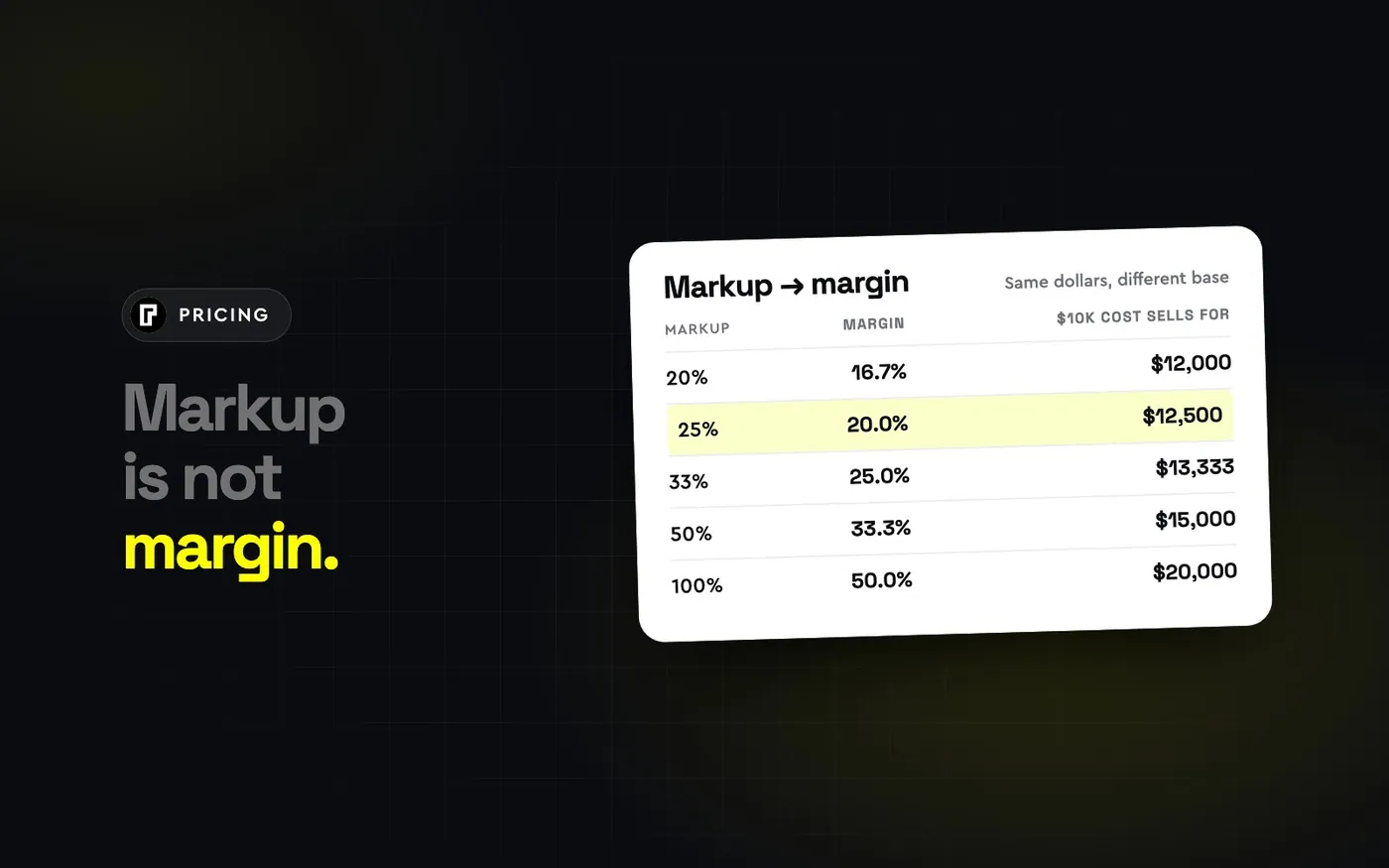
Markup is how much you add on top of cost. Margin is how much of the selling price is profit. They use the same dollars but a different base, so they are never the same percentage. Mark a $10,000 job up 20% and you sell it for $12,000, but your margin is $2,000 / $12,000 = 16.7%, not 20%.
Mixing the two up is one of the most common reasons contractors finish a busy year with less money than they expected. This guide gives you the formulas, a conversion table and a way to set markup from the margin you actually need.
Markup vs margin: the formulas
- Markup % = (price - cost) / cost x 100
- Margin % = (price - cost) / price x 100
- Price from markup = cost x (1 + markup)
- Price from margin = cost / (1 - margin)
Worked example: a bathroom costs you $20,000 in labor, materials and subs.
- At 25% markup: price = $20,000 x 1.25 = $25,000. Margin = $5,000 / $25,000 = 20%.
- To hit a 25% margin: price = $20,000 / 0.75 = $26,667. Markup = 33.3%.
That gap of $1,667 is the money people lose when they think "25% markup" means "25% margin".
Markup to margin conversion table
| Markup | Margin | Margin | Markup needed | |
|---|---|---|---|---|
| 10% | 9.1% | 10% | 11.1% | |
| 15% | 13.0% | 15% | 17.6% | |
| 20% | 16.7% | 20% | 25.0% | |
| 25% | 20.0% | 25% | 33.3% | |
| 30% | 23.1% | 30% | 42.9% | |
| 35% | 25.9% | 35% | 53.8% | |
| 40% | 28.6% | 40% | 66.7% | |
| 50% | 33.3% | 45% | 81.8% | |
| 60% | 37.5% | 50% | 100.0% | |
| 100% | 50.0% |
Quick rule: margin is always lower than markup, and the gap widens as the numbers rise.
Gross margin vs net margin
Gross margin is what is left after direct job costs (labor, materials, subs, equipment). Net margin is what is left after overhead too: office, vehicles, insurance, software, your own salary, marketing and the estimates you lose.
Residential remodelers and builders commonly target gross margins in the 30-40% range and net margins in the high single digits to mid teens. Your numbers depend on your trade, volume and overhead, so calculate them from your own books rather than copying someone else's.
How to set your markup from overhead and profit
- Add up annual overhead. Everything that is not a direct job cost. Say $240,000.
- Forecast annual direct job costs. Say $1,200,000.
- Pick a net profit target. Say 10% of revenue.
- Work out the revenue you need. Revenue = (job costs + overhead) / (1 - profit target) = (1,200,000 + 240,000) / 0.90 = $1,600,000. Gross margin = (1,600,000 - 1,200,000) / 1,600,000 = 25%.
- Convert to markup: 25% margin = 33.3% markup on direct cost.
If you mark up 20% because that is "what everyone charges", you would bring in $1,440,000, cover overhead and make roughly nothing.
General contractor markup on subcontractors and materials
- On subcontractors, GCs commonly add 10-20%. You are coordinating, scheduling, guaranteeing the work and carrying the payment risk; that has a cost.
- On materials, markups vary more widely. Many contractors use a lower markup on big-ticket items clients can price online (appliances, fixtures) and a higher one on everything else.
- On labor, your rate should already include burden (payroll taxes, insurance, benefits) before markup.
Some contractors use one markup across the job; others mark up each category differently. Either works if the blended number hits your required margin. Check the blended margin on every estimate, not just the markup you typed in.
Five ways contractors lose margin after pricing correctly
- Underestimated quantities. A missed room or wrong waste factor comes straight out of profit.
- Stale material prices. Pricing from a three-month-old spreadsheet on volatile materials.
- Unbilled changes. Small client requests done on site that never become change orders.
- Slow collection. Carrying costs on unpaid invoices.
- No job costing. If you only find out at year end, you cannot fix the next estimate.
Worked example: one job, three ways
A basement finish with these direct costs:
| Cost | Amount |
|---|---|
| Your labor (burdened) | $14,000 |
| Materials | $11,000 |
| Electrical and plumbing subs | $9,000 |
| Total direct cost | $34,000 |
Option 1: flat 20% markup on everything. Price = $40,800. Gross margin = 16.7%. If your overhead is 18% of revenue, you lose money on this job.
Option 2: split markups. Labor 45%, materials 25%, subs 15%. Price = $20,300 + $13,750 + $10,350 = $44,400. Gross margin = 23.4%.
Option 3: price to a target margin. You need 32% gross margin to cover overhead and a 12% net profit target. Price = $34,000 / 0.68 = $50,000. Markup = 47%.
Same job, same costs, a $9,200 spread in price. The right answer is whichever one covers your real overhead and profit target, which is why you need to know those numbers before you pick a markup.
How to talk about markup with clients
Clients sometimes ask why your price is higher than the sum of materials and labor they found online. A few approaches that work:
- Do not show markup line by line on a fixed price job. Present a price for an outcome, not a cost breakdown.
- On cost plus jobs, be completely open. The fee is in the contract and the costs are documented.
- Explain what the price includes: supervision, scheduling, insurance, warranty, cleanup, permits and the risk of things going wrong. That is real work.
- Give options instead of discounts. If the price is too high, offer a different material or scope rather than cutting your margin.
Markup on change orders
Change orders deserve at least your standard markup, and often more. They interrupt the schedule, need re-ordering, and pull the project manager off planned work. Many contractors set a change order markup a few points above their contract markup and state it in the contract so it is not a surprise. Whatever you choose, price every change before doing the work. Unpriced extras done "to keep the client happy" are one of the fastest ways to erase a job's margin.
How to improve construction profit margins
Raising markup is only one lever. Contractors who consistently hit their margin tend to do the following:
- Know their numbers. Annual overhead, burdened labor rates and real gross margin by job type, updated at least yearly.
- Estimate from a library, not from memory. Saved items and assemblies with tested quantities and prices make every estimate consistent.
- Price materials from current costs. Especially on lumber, copper, roofing and anything that moved in the last quarter.
- Sell options. Good, better, best choices let clients spend more without you discounting.
- Bill progress payments on time. Cash in hand reduces financing costs and stress.
- Review finished jobs. Compare estimate to actual on every job and feed what you learn into the next estimate.
- Say no to bad-fit work. Jobs outside your trade or region rarely hit the same margin as your core work.
Pricing with the margin you actually need
In Bolster, markup and profit are built into the items and assemblies in your estimate templates, so every quote starts from the margin you set rather than a number typed in at the end. Pro and Premium plans price items with AutoCost live regional material and labor costs, so the cost side of the formula is current. Once the job is sold, the estimate becomes the budget and job costing shows whether you are holding margin while there is still time to act.
See how construction estimating software handles markup, or book a demo and bring a recent job.
Frequently asked questions
What is the difference between markup and margin?
Markup is profit as a percentage of cost. Margin is profit as a percentage of the selling price. The same job always has a higher markup percentage than margin percentage.
How do I convert markup to margin?
Margin = markup / (1 + markup). A 25% markup is 0.25 / 1.25 = 20% margin.
How do I convert margin to markup?
Markup = margin / (1 - margin). A 30% margin needs 0.30 / 0.70 = 42.9% markup.
What is a typical general contractor markup?
It varies by market and job size, but residential GCs often mark up subcontractors 10-20% and set overall markup to hit a gross margin of roughly 30-40%. Calculate yours from your overhead and profit target.
Should overhead be included in markup?
Yes. Markup has to cover overhead and profit. If overhead is not built in, every job looks profitable on paper while the business loses money.
Is a 20% markup a 20% profit?
No. A 20% markup is a 16.7% gross margin, and net profit is lower again once overhead is paid.